


For Backing Up Parallels To An External Hard Drive, Should It Be Formatted For Mac Or Pc
Posted on by admin
dw5.netlify.app › 〓 For Backing Up Parallels To An External Hard Drive, Should It Be Formatted For Mac Or Pc 〓
For Backing Up Parallels To An External Hard Drive, Should It Be Formatted For Mac Or Pc 3,5/5 6360 votes
- Backup External Hard Drive Mac
- External Hard Drive Computer Backup
- Backup Entire Computer To External Hard Drive
So, you just bought an external hard drive or a portable SSD and wanted to use it on your Mac. But somehow, macOS doesn’t allow you to write data to the drive.
That’s all because it’s been initialized with Windows NT File System (NTFS), which is primarily for PCs. Apple Mac machines support a different file system.
I am trying to access a PC formatted external hard drive, however when I attempt to mount it I get a message saying the drive is not recongnized and if I want ti initialize, which i believe if I execute will remove the files I am trying access.Is there a way to access the files on the external hard drive.it is a avi file i need to edit. Possibly the best solution to using a hard drive with both Windows and Mac without the use of third-party software is creating two partitions on the drive, one for Windows and one for Mac. If the company's latest smartwatch is on your wrist, we want to read your review.
In this post, I’m going to show you how to format your external drive for a Mac compatible file system i.e. Mac OS Extended (Journaled). Just follow this easy step-by-step guide and you’re all set.
Important note: If you have useful files stored on the external drive, be sure to copy or transfer them to another safe place prior to formatting. The operation will erase all data and your files will be gone for good. You could use a recovery program like Data Rescue to retrieve them, but the odds of recovery vary.
Pro tip: If your external drive has a large volume, like mine – a 2TB Seagate Expansion. I highly recommend you also create multiple partitions. I’ll also show you how to do that below.
Most External Hard Drives Are Initiated with NTFS
During the last several years, I’ve used several removable drives, including a 500GB WD My Passport, 32GB Lexar flash drive, and a few others.
Three weeks ago, I bought a brand new 2TB Seagate Expansion to backup my MacBook Pro before I updated to the latest macOS, 10.13 High Sierra (also see those High Sierra issues I encountered).
When I connected the Seagate to my Mac, the drive icon showed up like this.
When I opened it, the default content was all there. Since I wanted to use it on Mac, I clicked the blue logo with the text “Start_Here-Mac”.
Backup External Hard Drive Mac
It brought me to a webpage on Seagate’s site, where it clearly indicated the drive was initially set up to work with a Windows PC. If I wanted to use it with Mac OS or Time Machine backup (which is my intent), I’ll need to format the drive for my Mac.
I then right-clicked the external drive icon on Mac desktop > Get Info. It showed this format:
Format: Windows NT File System (NTFS)
What is NTFS? I’m not going to explain here; you can read more on Wikipedia. The problem is that on macOS, you can’t work with files saved on an NTFS drive unless you use a paid app Paragon NTFS for Mac.
How to Format an External Drive to Work with Mac (from NTFS to Mac OS Extended)?
Note: The tutorial and screenshots below are based on macOS Sierra 10.12.5. They might be different if your Mac has a different version.
Step 1: Open Disk Utility.
The quickest way to do this is a simple Spotlight search (click the search icon on the upper right corner), or go to Applications > Utilities > Disk Utility.
Step 2: Highlight your external drive and click “Erase”.
Make sure your drive is connected. It should show up on the left panel under “External”. Select that disk and click the “Erase” button, the one highlighted in red in the screenshot below.
Step 3: Select “Mac OS Extended (Journaled)” in Format.
A new window will pop up asking which file system you’d like to format the external drive to. By default, it’s the Windows NT File System (NTFS). Select the one shown below.
Pro tip: If you want to use the external drive for both Mac and PC, you can also select “ExFAT”. Learn more about the differences between these file systems from this thread.
By the way, you can also rename your external drive.
Step 4: Wait until the erasing process is complete.
For me, it took less than a minute to format my 2TB Seagate Expansion.
You can also check to see if the format was successful. Right-click on the icon for your external drive on Mac desktop, then select “Get Info”. Under “Format”, you should see text like this:
Congratulations! Now your external drive has been formatted to be fully compatible with Apple MacOS, and you can edit, read, and write files to it as you want.
How to Partition an External Hard Drive on Mac
If you want to create multiple partitions on your external hard drive (in fact, you should for better file organization), here’s a step-by-step guide:
Step 1: Highlight your drive and click “Partition” in Disk Utility.
Open the Disk Utility app and highlight your external hard drive. Make sure you select the disk icon right under “External”. If you select the one below it, the Partition option will be greyed out and become unclickable.
External Hard Drive Computer Backup
Step 2: Add partitions and allocate volume for each one.
After clicking “Partition”, you’ll see this window. Located on the left is a big blue circle with the name of your external drive together with its volume size. What you need to do next is click the add “+” button to increase the number of partitions on your external disk. Then allocate the desired volume to each partition. You can do that by clicking the small white circle and dragging it around.
After that, you can rename each partition and define a file system for it.
Step 3: Confirm your operation.
Once you hit “Apply”, a new window pops up asking for your confirmation. Take a few seconds to read the text description to make sure it reflects what you intend to do, then click the “Partition” button to continue.
Step 4: Wait until it says “Operation successful.”
To check whether the operation is really successful, go to your Mac desktop. You should see multiple disk icons show up. I chose to create two partitions on my Seagate Expansion — one for backup, the other for personal use. You can find more info in this post: How to Backup Mac to an External Hard Drive.
That wraps up this tutorial article. I hope you find it helpful. As always, let me know if you have any issues during the formatting or partitioning process.
The Right Connections
Buying an external hard drive for your Mac is not all that different from buying one for your Windows PC, except for one very important complication: Newer MacBooks and MacBook Pros only come with Thunderbolt 3 ports, but the arrival of Thunderbolt 3-equipped drives has been a trickle, rather than a flood. Most of the current models are designed for photographers and video editors who need to store mountains of footage and access it very quickly. As a result, they are typically SSDs or RAID arrays, which means they're also very expensive. So what's a Mac user who just wants to back up his or her files using Time Machine to do? Read on as we answer that question, and solve your other Mac external-storage quandaries.
A New File System
Thunderbolt 3 and USB Type-C are the latest innovations in the external storage market, but before we get to them, we need to address a basic building block of hard drives that
An external drive's file system is the most important factor that determines whether or not it's readable by Macs, PCs, or both. With the release of the macOS High Sierra operating system, Cupertino ditched its venerable Mac OS Extended file system, commonly abbreviated as HFS+, and switched to an entirely new file format. It's simply called the Apple File System, and it's the first format to be across macOS products as well as the iOS ecosystem of iPads, iPhones, iPods, the Apple TV, and the Apple Watch.
There are many benefits to switching from HFS+ to the Apple File System, including better security thanks to native encryption, but the most important thing to note for external drive shoppers is backward-compatibility. Any drive formatted with HFS+ (which includes most Mac-specific drives on the market today) will work just fine with a Mac that's running macOS High Sierra or later.
Neither Apple File System nor HFS+ works with Windows, however. If you plan to use your external drive with computers that run both operating systems, you should consider a drive formatted with the exFAT file system. You won't get the security and efficiency of Apple File System, but you will get the convenience of being able to transfer files back and forth between Windows and macOS simply by plugging in and unplugging your drive.
Of course, you can easily reformat almost any drive you buy, so you're not limited to buying only those intended for use with Macs. If you really fancy a drive formatted for Windows (which will usually come preformatted in the NTFS format), you can use the Disk Utility in macOS to reformat it after you bring it home from the store. There are rare exceptions to this rule, such as the pro-oriented Akitio Thunder3 PCIe SSD, which uses a lightning-quick Intel SSD inside and relies on
SSD Versus Spinning Drive
Once you've settled on a file system, you then have to determine which storage medium you want:
A solid-state drive (SSD) offers quick access to your data because it stores your bits in a type of flash memory rather than on spinning platters. SSDs are often smaller and lighter than spinning external drives, as well, which is also thanks to the lack of moving parts. Their small size means they can often fit into a jacket or pants pocket, which makes them a better choice if you're looking for a portable external drive that you'll be carrying with you frequently.
One major downside, however, is that they're more expensive. You could pay more than 30 cents per gigabyte for an
For professional videographers who edit lots of 4K footage and gamers or movie buffs who have large libraries of multi-gigabyte titles, an external RAID array is worth considering, since it combines the speed of an SSD with the gargantuan capacities of a spinning drive. An array typically contains as few as two or as many as eight spinning drives, which all work together to
Backup Entire Computer To External Hard Drive
On the other hand, if you're looking to buy an external drive mainly to back up your files (which you should definitely do) and it will rarely leave your home office, an inexpensive spinning drive will work just fine.
Searching for Thunderbolt 3
So, to recap: Faster, smaller (both physically and in terms of gigabytes) solid-state drives come at a premium, while spinning drives offer a much better value while sacrificing speed. But what happens when you throw yet another variable into the mix: the connection between your drive and your Mac? As you might have guessed, the answer is more tradeoffs.
Almost every Mac laptop sold today comes with USB Type-C ports that support Thunderbolt 3, but other than a headphone jack, they are the only connectivity options available, which means you'll need an adapter to plug in any device that doesn't have a USB Type-C cable. Fortunately, Thunderbolt 3 via USB Type-C supports a blazing maximum potential throughput of 40Gbps, double the speed of the old Thunderbolt 2 standard and many times the 5GBps that USB 3.0 offers. Unfortunately, you won't find many Thunderbolt 3-compatible drives on the market currently. Even some Mac-specific drives are still sold with USB 3.0 connectors. Moreover, the Thunderbolt 3 drives you can buy are constrained by the maximum throughput of the drive itself, rather than the Thunderbolt 3 interface. With the exception of the Samsung Portable SSD X5, all of the external SSDs we've tested recently top out at around 600MBps, for instance.
This means that for now, it's best to include Thunderbolt 3 support in your buying decision only if you're concerned about futureproofing. While it's nice of manufacturers to include a USB Type-C cable for people who own a USB Type-C-only MacBook, you can pick up a converter for a few dollars online if the drive you're eyeing doesn't offer one. Meanwhile, iMacs, Mac Pros, Mac Minis, and the entry-level MacBook Air all still come with USB 3.0 ports, so they won't require adapters.
Other Considerations
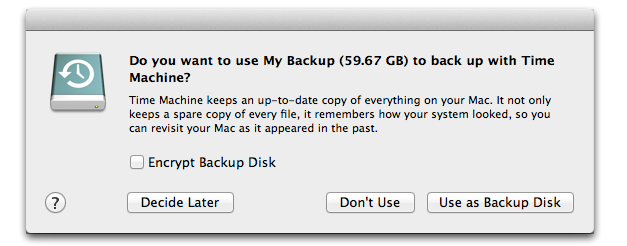
Drives intended for PCs sometimes come bundled with software that will automatically back up your files to the drive when it's connected, but such software isn't really a consideration for Mac users, who already have an excellent built-in backup option in the form of Time Machine. The first time you plug in an external drive, Time Machine will ask if you want to use it as a backup drive. While you can customize backup options in System Preferences, such as asking Time Machine to exclude certain folders, there's no action required on your part if you're happy with the default settings. The next time you plug in your drive, Time Machine will automatically set to work creating a backup.
Unless your drive is never going to leave your home or office, you should also consider its physical durability. Rugged, waterproof drives are a good option not just for surfers and BMX riders, as their marketing seems to suggest, but also for people who are carrying their drives to and from school or work, where they might occasionally get spilled on or dropped on the floor. (Check out our favorite rugged drives.)
Finally, you might want to consider how the drive will look when it's plugged into your Mac. Some drives come in a variety of colors. Many others feature copious amounts of aluminum and industrial-chic styling to match the design cues of your MacBook or iMac.
Ready for Our Recommendations?
We've selected a few of our favorite drives for Macs below; for more, check out our main list of best hard drives. You can also read our full list of hard drive reviews, as well as our top SSDs.
Best External Hard Drives for Macs Featured in This Roundup:
CalDigit Tuff Review
MSRP: $179.99Pros: Rated to survive 4-foot drops. Certified waterproof and dustproof. Comes with USB 3.0 and USB-C cables.
Cons: Warranty limited to two years. SSD option is still unreleased.
Bottom Line: Not only is the CalDigit Tuff a rugged hard drive designed to survive extreme conditions, it's also a terrific value.
Read ReviewWestern Digital My Book Review
MSRP: $249.99Pros: Comes in a variety of large capacities. Three-year warranty.
Cons: Requires external power adapter.
Bottom Line: With a full 8TB for less than $250, the 8TB version of the Western Digital My Book is a deep well of affordable storage for your photos, music, videos, and more.
Read ReviewLaCie Mobile Drive Review
MSRP: $94.95Pros: Slick, faceted design. Solid-feeling aluminum enclosure. Useful LaCie Toolkit software handles backup and restore, as well as mirroring. On-the-mark performance.
Cons: A little hefty. Toolkit utility requires a download.
Bottom Line: A metal-skinned gem of a platter hard drive, the LaCie Mobile Drive looks great and performs on point. It's geared to macOS users, but it will please anyone with an eye for style in their gadgets.
Read ReviewSeagate Backup Plus Ultra Touch Review
MSRP: $89.99Pros: Fabric-covered enclosure. Small and light. Seagate Toolkit provides handy backup/recover functions, as well as mirroring. Data protected by password and AES-256 hardware encryption.
Cons: Fabric cover a bit slippery to grip. Seagate Toolkit a separate download.
Bottom Line: Combining on-point performance and strong encryption, Seagate's Backup Plus Ultra Touch portable drive is a great choice for everyday backups and security-first use alike. Plus, a fabric coat adds appeal.
Read ReviewSamsung Portable SSD T5 Review
MSRP: $799.99Pros: Excellent performance. Includes USB 3.0 and USB-C cables. Compact. Android-, Mac-, and Windows-compatible.
Cons: Parallels desktop 11 for mac key. While a comparable good per-gigabyte value, the drive itself is expensive.
Bottom Line: Samsung's Portable SSD T5 drive has a speedy USB-C interface, plenty of reliable storage, and it takes up about as much room in your pocket as a short stack of credit cards.
Read ReviewAkitio Thunder3 RAID Station Review
MSRP: $369.99Pros: Excellent connectivity options and transfer speeds. Solid build quality and attractive aluminum finish. Easy disassembly. Cooling fan can be disabled. No software required for Macs. Hardware RAID controller.
Cons: Expensive. SATA interface limits read/write speeds. Only 27W of power delivery.
Bottom Line: With its wealth of ports, the Akitio Thunder3 RAID Station is both a connectivity hub and a capacious external hard drive for multimedia content creators.
Read ReviewCalDigit AV Pro 2 Review
MSRP: $249.99Pros: Relatively low cost per gigabyte. 7,200RPM. Drive is easily removable from its enclosure. Thunderbolt 3 support.
Cons: Included Thunderbolt 3 cable is short. No DisplayPort or Thunderbolt 3 pass-through via USB-C.
Bottom Line: Aimed at multimedia professionals, the CalDigit AV Pro 2 is a well-designed, Mac-formatted external drive that comes in SSD and spinning disk versions, and includes both a USB hub and Thunderbolt 3 support.
Read ReviewPromise Pegasus3 R4 Review
MSRP: $1499.00Pros: Internal power supply. Little to no setup required. Supports daisy-chaining other Thunderbolt 3 devices. Lightning-quick file transfer times.
Cons: Does not boast class-leading throughput.
Bottom Line: One of just a few options for Mac-formatted external RAID arrays, the Promise Pegasus3 R4 is a good choice if you need to store mountains of data and access it quickly.
Read ReviewSamsung Portable SSD X5 Review
MSRP: $699.99Pros: Extremely fast data transfer speeds, thanks to Thunderbolt 3 and PCIe NVMe interfaces. Multiple capacity options. Sleek design.
Cons: Expensive. Heavy. No USB support. Difficult to connect to Windows PCs.
Bottom Line: The sleek, expensive Samsung Portable SSD X5 offers the fastest single-drive external storage money can buy, but it's suited mainly to well-heeled content-creation pros using late-model Macs.
Read ReviewWestern Digital My Passport Wireless SSD Review
MSRP: $499.00Pros: Durable. Built-in SD card reader and USB port. Plex support. Doubles as a power bank.
Cons: Expensive. No Thunderbolt support.
Bottom Line: The Western Digital My Passport Wireless SSD is pricey, but this feature-packed drive can do much more than just wirelessly transfer files.
Read Review