


How To Set Parallels For Mac To Be Integrated To Mac
Posted on by admin
How To Set Parallels For Mac To Be Integrated To Mac 4,2/5 5686 votes
- If you wish to use Windows on your Mac without the headache of rebooting, then Parallels for Mac is your best bet. It is almost the fastest, well-integrated solution to access Windows apps in OS X.
- The Parallels plugin is a great add-on for SCCM 2012 and will provide much of the same functionality that is seen on Windows computers. It really extends the out-of-box capabilities of SCCM to Mac. I would recommend it for any organization that is running SCCM 2012 and has both Windows and Mac computers.
- Running Parallels On A Mac
- Using Parallels On Mac
- Parallels For Mac Free
- Parallels Switch Back To Mac
- Parallels On Mac
- Parallels For Mac Review
Sometimes, Mac users need to run Windows software. Maybe there’s a program you need for work that doesn’t offer a Mac version, or maybe you occasionally need to test websites in Internet Explorer. Whatever you need Windows for, Parallels is the best tool for the job.
Parallels Toolbox for Mac and Windows 30+ tools in a lightweight, powerful, all-in-one application for Mac ® and PC. Easy to use and economical—a whole suite of tools for a fraction of the cost of individual apps, packaged in one simple interface.
Why Use Parallels Instead of Boot Camp or VirtualBox?
RELATED:How to Install Windows on a Mac With Boot Camp
Running Parallels On A Mac
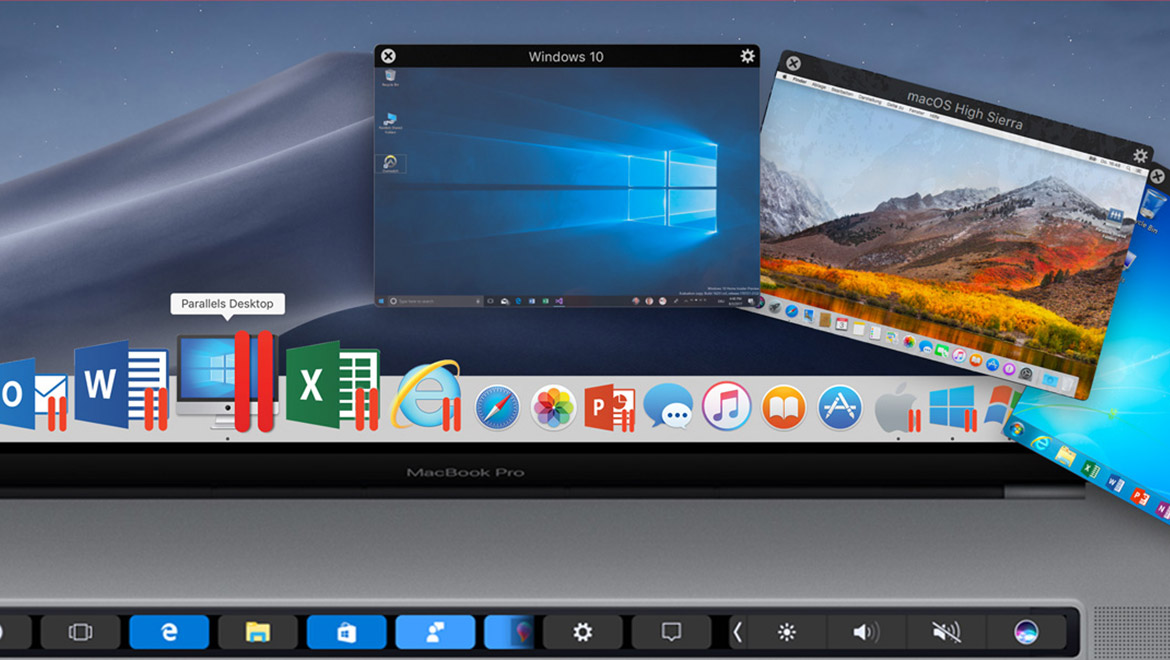
Sure, you could set up your Mac to run Windows with Boot Camp, but that means restarting your computer every time you need to use Windows. Parallels runs Windows within macOS, using what’s called a Virtual Machine. This allows you to quickly switch between the Mac and Windows desktops. You can even combine the two desktops, if you want, and run Windows software right on your Mac desktop from your Mac’s dock.
Virtual machines are complicated, but Parallels makes it reasonably simple to set one up and use it. There are other virtual machine options available to Mac users, including the open source VirtualBox, but Parallels is different in that it’s designed exclusively with Mac users in mind. Parallels costs more (since VirtualBox is free and Parallels is not), but there are hundreds of little design touches that help make running Windows within macOS as painless as possible, and that make setting everything up quick and easy. it’s well worth the cost.
How Much Does Parallels Cost?
Using Parallels On Mac
Browsing the Parallels website, it can be a little tricky to find out what the product actually costs. So here’s a quick breakdown:
- Purchasing the latest home version of Parallels Desktop costs $80 as of this writing. This lets you run Parallels on a single Mac.
- Upgrading from one version of Parallels to another generally costs $50, and will probably be necessary every couple of years if you keep installing the latest versions of macOS.
- A $70 annual subscription gives you access to all updates “for free,” according to the Parallels website.
RELATED:How to Make Linux and macOS Virtual Machines for Free with Parallels Lite
If you just want to try out Parallels and see if it works for you, you can: there’s a 14 day trial of the software, which you can access without providing a credit card number. There’s also Parallels Desktop Lite, which is free on the Mac App Store and lets you create both Linux and macOS virtual machines. Parallels Desktop Lite can only run Windows virtual machines if you pay for a subscription, however.
One more note: purchasing Parallels does not give you a Windows license, or a Windows product key. If you have a Windows installation CD or USB key handy with a valid license you can use that, otherwise you will need to purchase Windows 10 from Microsoft to create a Windows 10 virtual machine.
RELATED:You Don’t Need a Product Key to Install and Use Windows 10
We’ll point out that you don’t technically need a product key to install and use Windows 10—Microsoft basically gave up enforcing their license requirements with Windows 10, and you can download Windows 10 right from Microsoft at no cost (you’ll probably want it in the form of an ISO file). Legally speaking, however, you still need a product key to use Windows, even in a virtual machine.
How to Install Windows in Parallels
Got everything you need? Good. The new virtual machine wizard, which launches the first time you open Parallels, makes the process simple.
Assuming you already have a Windows CD or ISO, click the “Install Windows or another OS from a DVD or image file” button.
The ISO or DVD should be found automatically; otherwise, click the “Locate Manually” button. Then click “Continue.”
You’ll be asked whether you want an Express installation, which automates the installation process so that you don’t need to enter the product key or click “Next” during the installation process.
Premium appliance brands and expert service available inside select Best Buy stores. Camera Experience Shop Shop a wider selection, talk to a camera expert and try before you buy at select. Buy Parallels Desktop 14 for Mac. Run Windows, Linux, or Popular Oses on your Mac. Buy New License or Upgrade Now. Where to buy parallels for mac. Parallels Desktop 14 for Mac makes it easier than ever to get back space on your Mac! Get up to 20 GB back with new disk usage optimization. Automatically reorganize your virtual disk to increase limits for optimal storage savings.
Choose this option if you want, otherwise plan on babysitting the installation a little bit.
Next you’ll be asked what you plan on using this virtual machine for: work-related software or gaming.
If you select Games only, the virtual machine will be set to use a lot more resources, so only click that if you intend to do serious gaming in the virtual machine (which is probably not a great idea). Also make sure your Mac even has enough resources to dedicate—if you spread your computer’s resources too thin, your virtual machine will be very slow. You can change these settings later, but I recommend going with “Productivity” in almost all cases.
Finally, you’ll be asked for a few details: what the machine should be named, where it should be located, and whether you want a shortcut to the machine on your desktop.
You can also configure the settings before installation—don’t worry, you can tweak any of those later if you’d rather not dive in right now. Click “Continue.”
The Windows installer will run. If you selected the Express installation, you won’t need to do anything: just watch as Windows installs. If not, you’ll have to click “Next” a bunch of times and enter your product key, as is normal for installing Windows.
The installation process can take a while, if mechanical hard drives or a DVD is involved. If everything is running off an SSD, however, you’ll be up and running in a few minutes.
Eventually you’ll see the Windows desktop! We’re almost done.
How to Seamlessly Integrate Your Virtual Machine Into macOS
That’s all well and good, and you can start using Windows now—but if you really want to get the best of what Parallels has to offer, you have a few more steps ahead of you.
Parallels For Mac Free
At the top-right of your virtual machine you’ll see a caution sign. This is letting you know that Parallels Tools needs to be installed. Installing this lets you move your mouse between macOS and Windows in one swift motion, and also makes it possible to access your Mac files from within Windows. To get started, click that caution sign, then click “Install Parallels Tools.”
Doing this will mount a virtual CD in the Windows virtual machine. You’ll be asked what you want to do by Windows; select “Install Parallels Tools.”
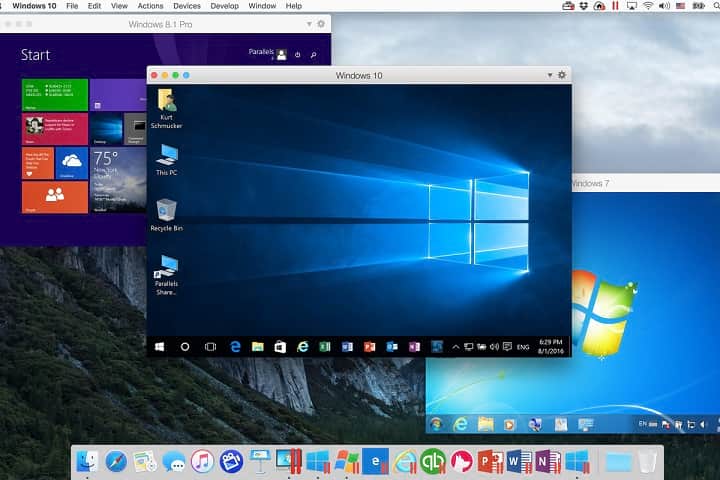
The installer will take a few minutes, and eventually will require you to restart Windows. Do that and you’ll be up and running: your virtual machine will be integrated with macOS.
Once Parallels Tools is installed, Windows integrates very cleanly with macOS. There are all kinds of examples of this:
- Moving your mouse to your Windows virtual machine is seamless.
- Anything you copy to your Windows clipboard can be pasted in Mac apps, and vice-versa.
- The Documents, Downloads, and Desktop folders in Windows are symbolically linked to the same folders in macOS. Change a file in one place and it changes in the other.
- If you have Dropbox or iCloud running in macOS, those folders are available in Windows Explorer.
- If you have OneDrive set up in Windows, that is available to you in macOS.
- Individual Windows programs are shown in your Mac’s dock.
We could go on: the extent of the integrations is staggering. If any of them bother you for any reason, you can change them by shutting the virtual machine down, then clicking the Settings button for it.
Head to the “Sharing” tab to disable the folder sharing.
And head to the “Applications” tab to stop Windows applications from showing up in your Mac dock.
There are all kinds of other settings we could explore, but this article is only a starting point. Dive in and experiment.
More Than Just Windows
Parallels isn’t just for running Windows, either: you can use it to set up Linux, ChromeOS, and even macOS virtual machines.
We outlined how to create Linux and macOS Virtual machines in Parallels Desktop Lite, and the process is identical for the full version of Parallels Desktop, so check out that article if you’re interested.
RELATED:How to Free Up Disk Space in Parallels
Parallels Switch Back To Mac
If you intend to create a lot of virtual machines, you should also read about freeing up disk space in Parallels, because these machines will eat up a lot of hard drive space.
READ NEXT- › What Should You Do If You Receive a Phishing Email?
- › Why Do You Have to Log In to Your Home PC, Anyway?
- › The Best New Features in Android 10, Available Now
- › How to Use the chown Command on Linux
- › What’s New in Windows 10’s 20H1 Update, Arriving Spring 2020
Parallels On Mac
Question
- I want to know how Parallels Desktop© for Mac uses Mac video card resources.
- I have a Mac Pro with two video cards working via AMD Crossfire™ or NVIDIA SLI technologies, can I use both cards in my virtual machine?
How Parallels Desktop works with video cards
Parallels Desktop has no access to Mac's physical graphics cards. Instead, Parallels Display Adapter driver (which is part of Parallels Tools installation) interfaces with virtual hardware and provides 3D acceleration features. The actual acceleration is achieved by translating DirectX commands from guest OS to OpenGL API on macOS side.
Most of Macs have an integrated graphics, which is built-in to motherboard and shares memory with the CPU, it provides a more economical alternative to the stand-alone card, known as 'discrete graphics' or 'dedicated graphics'. In this case Parallels Desktop will use the resources of Mac's built-in graphics.
Working with discrete graphics card
If your Mac has discrete graphics, Parallels Desktop can use macOS 'Automatic graphics switching' for its virtual machine(s). To learn more about the feature please visit Apple's KB HT202043.
NOTE: Parallels Desktop does not control when to switch between graphics cards, this decision is taken by macOS.
Parallels For Mac Review
To make sure this option is enabled go to virtual machine configuration window ->Hardware ->Graphics - Advanced Settings
Working with two or more cards
The main purpose of Crossfire (by ATI/AMD) and SLI (by NVIDIA) technologies is to unify pair of 3D accelerators in the sake of increased performance. That way applications keep using standard API (OpenGL or DirectX) and the driver splits tasks between two physical video cards. It is rather a simplicity, because some tasks may be split more efficiently than others. It is explained more precisely in specific guidelines for developers. However, the main point is still there – it is driver’s work to split tasks between video cards, as only driver can optimize input data for video cards, synchronize card’s work and only it has required data regarding technical specifications.
Apple uses its own video driver for macOS. This is the reason why macOS is not supporting Crossfire, nor the SLI. Contrary to Windows where drivers belong to vendors, in Mac drivers belong to Apple (even though developed in collaboration with vendors) and features are controlled by Apple as well. That, basically, means that Mac OS X and it’s drivers can be considered as the one, hence cannot be split. That is why Mac OS X applications consider two video cards working in tandem as two separate video cards. And it is up to these applications to somehow split tasks between two cards, or just use one instead.
Since Parallels video card is virtual and relatively high-level (we do not work with hardware directly, but via API or OpenGL instead), it is not possible to effectively split tasks between two video cards as we are not emulating SLI/Crossfire. In theory (just in theory!) we could map both video cards to guest OS and somehow allow applications to use it. But there is no practical need for that as there is very tiny amount of peculiar Windows applications that could utilize two cards (because it is much more complicated process than SLI/Crossfire).