


Parallels Access For Mac
Posted on by admin
Parallels Access For Mac 3,8/5 7208 votes
When I first set up the Mac mini (the new machine), Parallels Access on my iPad showed only two machines--the original tbrown_imac and TrudyRetina. When I connected to tbrown_imac, it actually connected to tbrown_mini. So I changed its name to tbrown_mini on the iPad. Aug 28, 2013 Download Parallels Access and enjoy it on your iPhone, iPad, and iPod touch. Parallels Access is the fastest, simplest, and most reliable way to remotely access all your Windows and Mac applications and files from your iPhone or iPad. Parallels Desktop for Mac Build 5608 added support for guest Parallels Tools for Linux in the latest Linux distributions (including Ubuntu 8). It also added support for running 3D graphics in Windows virtual machines on Mac OS X Leopard 10.5.3. Manage and access all your files in the cloud, on remote computers, and on local devices with Parallels Access Universal File Manager. Copy and paste to your mobile device—or open cloud files on a remote desktop—with a single click. Parallels Access offers fast, optimized remote access to Mac and Windows computers from any iPhone, iPad, or iPod touch tailored expressly for mobile devices. A tool called Parallels Transporter was included to allow users to migrate their Windows PC, or existing VMware or Virtual PC VMs to Parallels Desktop for Mac. Netsys lawsuit [ edit ] This section needs to be updated. 如果您拥有 Parallels Desktop 14 for Mac 永久许可证,则可以获得三个月的 Parallels Access 订阅。 借助 Parallels Desktop 14 for Mac Home 或 Pro Edition 订阅,Parallels Access 在 Parallels Desktop 订阅期限内有效。.
- Access Parallels Files From Mac
- Parallels Access Mac Offline
- Microsoft Access For Mac
- Microsoft Access For Macbook
- Parallels Cannot Access Mac Home
- Parallels Access For Mac
- Parallels Access Mac Folders From Windows
I recently had a chance to review Parallels Desktop 9 for Mac. Parallels also allowed me to try Parallels Access ($49.99/year for each computer), its new remote access solution for iPad users — but you don’t need to be using Parallels Desktop 9 for Mac or any other Parallels virtualization solution to take advantage of Parallels Access. I’ve written about other remote access solutions for TechRepublic, and Parallels Access really caught my attention at the first login.
Using Parallels Access
The Parallels Access app is a free download from the App Store. As part of the setup, you have to install a Parallels Access agent on your Mac or PC. Parallels Access has the following prerequisites:
- iPad 2, iPad 3, or iPad Mini
- Mac running OS X. Mountain Lion 10.7, 10.8, or Mavericks 10.9
- PC running Windows 7 or Windows 8
My one annoyance with the Parallels Access setup is the mandatory video that plays when you open the app for the first time on an iPad. If you're like me and don’t learn well from help videos, you’ll think the volume is too loud and find you can’t quit it. While I commend Parallels Access for the user assistance content upfront, it would be nice if they offered an option to skip the video for users who prefer reading documentation.
Parallels Access offers a full-screen view over apps on your PC or Mac. There's no wasting screen real estate with this app. It helps desktop apps look great on Retina display iPads. Figure A shows how Parallels Access renders the apps on my Mac.
Figure A
Apps available on my Mac via Parallels Access.
Tap on the plus sign [+ ] in the top right corner to bring up a list of other PC applications you can add to the Parallels Access App Launcher (Figure B).
Figure B
Parallels Access App Launcher.
Figure C shows the familiar Word Document Gallery that greets Word for Mac 2011 users when they fire up the app.
Figure C
Word Document Library.
Navigating through a desktop application using Parallels Access feels very natural. While an iPad running Parallels Access isn’t going to replace a laptop as a primary work machine anytime soon, I did find the performance to be very robust — both on my home Wi-Fi network and a test I ran on the free Wi-Fi at my favorite local bakery café. Parallels Access renders PC/Mac apps full screen on the iPad, which really helps heighten the user experience and differentiates the app from others in the market.
The toolbar at the bottom right corner lets you launch new apps. Figure D shows the App Launcher open. Tap on a new app in the launcher to open it.
Access Parallels Files From Mac
Figure D
App Launcher.
Tap the rocket icon to return to the opening page. When you tap on the gear icon, you get access to various options (Figure E), including additional keys, mouse pointer, sound, feedback, and help.
Figure E
Various options are available.
Tapping through the tabs and menu options in Word 2011 was responsive. I couldn’t feel any lag over my home Wi-Fi network when I was testing the Desktop keyboard feature. The same held true when I tested access over the free Wi-Fi at my favorite local café/writing spot.
The keyboard is well spaced out and even includes Windows and command keys (Figure F), which is a nice touch.
Figure F
Desktop keyboard.
The iPad native features might take some practice, but the copy and paste feature work as advertised. The SmartTap feature was nice when I tested it in Word 2011 and other common applications. The magnifying glass was also precise, and it was actually quite helpful.
Parallels Access agent
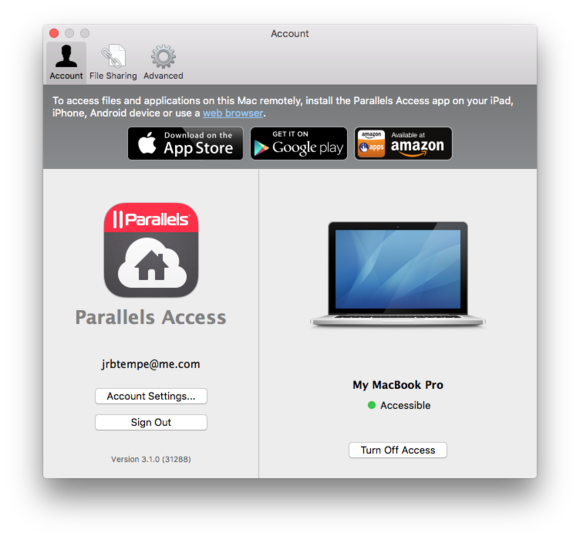
As part of the setup process, you have to install the Parallels Access agent on your PC or Mac. In the case of the Mac install, the app remains accessible on the Menu bar. Figure G shows the Account Settings dialogue available on the Mac/PC side.
Figure G
Account Settings dialogue.
There are also advanced settings (Figure H) that govern user access and locking from their iPad to the PC/Mac. My recommendation is to look at these advanced options during the Parallels Access trial period to see if they can benefit your remote access experience.
Figure H
Advanced Settings.
The application also gives you the option to modify the sleep settings on your Mac/PC to ensure that your machine is awake and ready for remote access. After installing Parallels Access on my Mac, the option to change my sleep settings appear whenever I power up my machine. If you plan on using Parallels Access, it’s an option you should explore using.
Final thoughts
Based on my experience reviewing a number of remote access apps for the iPad and other mobile devices, I highly recommend Parallels Access. The solution’s pricing might get expensive if you want to access multiple PCs or Macs, but this beautiful and robust app definitely caught my attention after spending time with other solutions.
Have you tested Parallels Access yet? Share your experience in the discussion thread below.
Parallels is best known to Mac users as one of the handful of companies—including VMWare and a couple of others—that make apps enabling you to run Windows on your Mac. Now the company is entering a much more crowded niche: Its new iOS app Parallels Access lets you connect to a remote Mac from your iPad and so 'run' Mac apps on your tablet. In doing so, it joins the likes of GoToMyPC, LogMeIn, TeamViewer HD, and SplashTop Remote Desktop, as well as VNC clients like Mocha VNC, among many, many others.
So if Parallels Access isn’t exactly unique in what it does, how does it expect to differentiate itself in that crowded field? By making remotely accessed Mac programs act as much like native iOS apps as possible. Based on my preliminary testing with the app, here’s how it works.
Installation and setup
Installing Parallels Access is a simple, two-step process. First you install an iOS client via the App Store. From that client app, you log into your existing Parallels account or create a new one. You then install a Mac “agent” on your desktop or laptop and log into that same account from there; the Mac app must be running in order for the remote access to work. (The Mac installer is smart enough to check your system’s sleep settings and advise you whether you need to adjust them; if your Mac goes to sleep while you’re remotely accessing it from your iPad, you’ll be out of business.) There’s an Access agent for Windows machines, too, so you can control those from your iPad as well.
With those two bits of software in place, you launch the iPad app, which will then show you a list of the Macs that are registered to your account.
Tap on the one you want and you’ll enter a Launchpad-like interface showing you a bunch of your Mac apps. (Which is to say it looks like a standard iOS home screen, but with Mac icons.)
Parallels Access Mac Offline
Parallels says that, by default, this initial list shows the Mac apps you use most commonly, but you can add and delete apps as you see fit: Just tap the Edit button in the upper right corner to delete or the plus-sign (+) to add. There’s also a handy search field, which will find any app with your search string, not just those on that default home screen.
Microsoft Access For Mac
The interface
When you tap on one of the icons on that home screen, the Mac app opens smoothly; I noticed no lag between my taps and the app’s response. (That’s not always the case with this kind of remote access.) If you were near the Mac you’re connecting to, you’d see the app open in full-screen mode on your Mac’s display(s). You could type and move the cursor from your Mac input devices, but the interface would be zoomed in on the one app that’s open on your tablet.
Access isn’t just mirroring your Mac’s screen on your iPad: It’s overlaying its own interface on your OS X apps. That means you interact with Mac apps by tapping, tapping-and-holding, clicking, dragging, and so on. A regular one-finger tap on the iPad produces a single left-click on your Mac, a two-finger tap creates a right-click, a slide of your finger scrolls the screen, and so on.
Save more than before with savings alerts and new offers delivered right to your inbox. • Coupons.com Mobile App Save effortlessly with paperless coupons! Parallels for mac versions.
On the right side of the screen, you’ll see a small toolbar with four icons on it. You can swipe over the toolbar left-to-right to hide it, then swipe in from right edge of the screen to have it reappear.
The top icon on that toolbar summons a Dock-like interface at the bottom of the screen, showing all of the apps that are currently open on your Mac. To switch to another app, you tap its icon there.
Below that on the toolbar there’s a Launchpad icon; you use that to summon that initial home screen with your Mac app icons; you can open new apps there.
Next there’s the familiar gear icon for settings. Tap on that to control six settings:
Microsoft Access For Macbook
- Additional Keys (which lets you summon special keyboard keys, about which more below);
- Mouse Pointer (tap on that to get a mouse-click toolbar that makes it easier to effect left- or right-clicks);
- Desktop Mode (which gives you a fuller OS X desktop, including the top menubar and the Dock);
- Sound On/Off;
- Feedback; and
- Help.
Finally, below that Settings icon, there’s a keyboard button that summons the Access keyboard. That keyboard is the standard iOS one, plus a set of special keys at the top: Escape; Tab; F1 through F12 keys; Delete; a button with a grid-like icon on it that, when tapped provides Home, End, PgUp, and PgDn keys; Shift; Ctrl; Alt; Command; and cursor arrow keys.
The Access keyboard doesn’t let you “chord” keys—in other words, you can’t use standard OS X keyboard combinations such as ⌘-B, ⌘-C, and so on. Instead, you must use the iOS-standard context menu (summoned by selecting text or whatever else you’re working on, depending on the app, then tapping the selection). On the plus side, you can use iPad dictation for input in your Mac apps.
Because you’re running OS X, you can run multiple apps at once, switching from one to the other using that app-switcher button in the toolbar. But because you’re in iOS, the Access interface is really optimized for running one app at a time. So if you need to hop among multiple apps, the Access interface could be frustrating.
Tapping on elements of an app’s interface—buttons in the Office ribbon, for example—works really well, in part because Parallels intelligently interprets taps that are close to buttons; you don’t have to hit them exactly.
Final thought
Parallels Cannot Access Mac Home
While Parallels Access does indeed provide a nice, smooth iOS interface to Mac programs, that’s not to say the app does so uniquely enough to clearly distinguish itself from the other iPad apps that do much the same thing. For that final word (as well as word on whether and how well you can stream video or transfer files from your Mac to iPad), you’ll have to wait for our review.
Parallels Access For Mac
Parallels Access will sell for an $80 annual subscription; you’ll need a separate subscription for each Mac (and PC) agent you install.
Parallels Access Mac Folders From Windows
Note: When you purchase something after clicking links in our articles, we may earn a small commission. Read our affiliate link policy for more details.