


Virtual Box Parallels Desktop 9 For Mac
Posted on by admin
Virtual Box Parallels Desktop 9 For Mac 4,8/5 157 votes
VirtualBox is a general-purpose full virtualizer for x86 hardware. Targeted at server, desktop and embedded use, it is now the only professional-quality virtualization solution that is also Open. Parallels Desktop 13 runs Windows and other operating systems in a virtual machine alongside your Mac apps. It's a good option for those who still rely on certain Windows apps for their business, or gamers who can't live without a favorite Windows game.
- Parallels Desktop 9 For Mac Free Download
- Parallels Desktop 9 Activation Key
- Parallels Desktop 13 For Mac
- Download Parallels Desktop For Mac
Parallels Desktop is a Mac application that allows virtualizing the Windows OS on any Mac. Like the VirtualBox for Windows, the Parallels Desktop also is a virtualization software where you could install the Windows or its applications seamlessly. It supports almost any Windows applications to run on your Mac. You don’t have reboot the Mac or select a different partition to install the extra OS. The automated processes can help you to run Windows applications as running a Mac application. No hassles or problems will be there in the setup or the maintenance.
Parallels Desktop 9 For Mac Free Download
So today, we decided to review the Parallels Desktop which will help thousands of people who are still in search of the perfect way to run Windows applications on Mac Osx. In this review, we will analyze the software top to bottom and will provide some of the most noticeable features alongside our final verdict. If you are one of those who wanted to run Windows applications on Mac, you should take a look at this review. So, let’s start.
What is Parallels Desktop?
As mentioned before Parallels Desktop is a Mac program that helps to run Windows applications on Mac. In other words, it is a virtual engine like many other softwares we already have seen on the market (like VMware.) It comes with very nice power management features to provide a better power consumption control throughout the usage. It reduces the resource usage of the virtual engine as much as possible resulting in the minimum power consumption. From our tests, there was only a slight difference in the power usage of the Mac even after running the Parallels Desktop software. This makes it possible to enjoy the virtual machine even on low battery or long journeys.
Parallels Desktop Interface
The Parallels Desktop interface is very easy to use where the necessary buttons and links are placed. There is also a wizard mode available on the software to make it even simpler to create and run virtual machines where any of the Windows or Linux programs running. The latest version of the software also includes many other platforms varies according to the edition. Even though, to create a virtual machine you have to sweat a little especially if you are a beginner. There are no exact documentations available with the software that describes the setup and maintenance process of the Windows or Linux virtual machines.
If you are familiar with such virtualization tools, the software will be quite easier to use, and you will never face an issue in any part of the software. Parallels Desktop is also coming with the support to add existing virtual machines in case you saved it earlier on any other storage medias. All in all, the interface and first look at the software will surely make you an impression.
Parallels Desktop Features
Here are some of the most noticeable features of the Parallels Desktop application. Having a look at them will help you in determining what you will get with it.
One-touch Tools
The One-touch tools in the Parallels desktop makes it easier to fulfill various tasks in the virtualized OS. To take a screenshot, cast your screen, access the internet, download videos, all you have to do is simply clicking some buttons. It is no more difficult to control your virtual machine.
Run Windows on your Mac without rebooting
You don’t have to reboot your Mac to run Windows on it. Simply open the Parallels software and create a virtual machine. Then start using it seamlessly until you get bored. At any point, the Windows needs to be restarted; you just restart the virtual machine instead of the Mac.
Use any Windows applications
It can run almost any windows application without any trouble. You can enjoy using any Windows applications on Mac like using a Mac program. No problems or bugs were found in our tests.
Optimized for Windows 10 and ready for MacOS Sierra
The Parallels Desktop is no more older. The software supports all the popular platforms including Windows 10 and the MacOS Sierra. So the compatibility will be no longer questioned.
500 GB of online backup storage for 1 year
To sweeten the features, the Parallels offers 500GB of online storage for the users. This is available with any edition of the program. If you have any of your important files to store from the virtual machine and you have access to the internet, you are so lucky.
Also Run other operating systems
If you bored of running just the Windows OS on the Parallels, it could also run various other platforms including Linux and Google Chrome OS. The supported platforms are ranging as, OS X, Windows 10, 8.1 & 7, Linux, and Google Chrome OS.
Easily switch between the operating systems
It is very easy to switch between the operating systems. For example, if you want to copy something from your virtual machine or to the virtual machine, the setup assistant is always there for you.
Good performance
Parallels Desktop runs quite good when compared to other softwares to run Windows on Mac. It uses very low resources except in high usage conditions like gaming on the virtual machine.
Retina Support
The new versions of the software are coming with Retina support independent on the resolution or other display features.
Non-Compromised Security
Even if you are using a virtual machine, the security of the OS will be non-compromised. You could set separate passwords for any of the virtual machines or folders to secure it from external access. This is a unique feature that we can’t see on other competitors.
Pros
- Run Windows and Linux Virtual Machines on Mac
- Improved integration between Mac and Windows programs
- Even some games are supported
- Very power efficient
- Supports macOS Sierra and Windows 10 Anniversary Update
- Not completely free
- Sometimes, uses high resources (Especially for gaming)
- No much guidance for the new users
Cons
Verdict
Parallels Desktop is an unquestioned Windows emulator for Mac. With its features and the ability in running almost any Windows programs, Parallels Desktop dominating the virtual machine industry on Mac. A new license of the software starts from $79.99 and varies according to the editions. If you would like to give a try to the software before going to buy it, you could do that from the following link. Thousands of people already using Parallels Desktop to run Windows on Mac, you also give it a try.
Parallels Desktop for Mac Review: Run Windows on Mac
View Gallery
Parallels Desktop 9 Activation Key
$79.99
- Pros
Fast performance in testing. Tight integration with guest OSes. Effortless installation. Flexible file and folder tools. Options for opening Mac files in Windows apps. Can install macOS virtual machines directly from the Mac recovery partition.
- Cons
Some Mac-integration features can be confusing or impractical until you turn them off. Only runs on a Mac, so you can't share guest machines with Windows or Linux users.
- Bottom Line
Parallels Desktop is an excellent way to run Windows apps on MacOS, especially for ordinary users. It's fast in testing, offers tight integration between Macs and guest systems, and supports many other OSes, too.
Parallels Desktop is the fastest and friendliest way to run Windows apps on a Mac for the majority of users who are likely to want to do so. IT pros may prefer VMware Fusion; expert users who want no-cost apps will prefer the open-source VirtualBox. Hardcore gamers may prefer Apple's Boot Camp, which lets users boot directly into Windows, with the added bonus of native graphics card support. For most ordinary Mac users who prefer Windows versions of apps like Microsoft Office or AutoCAD, however, or who use Windows-only apps like CorelDraw or WordPerfect Office, Parallels Desktop is the clear first choice for virtualization software.
- $79.99
- $0.00
- $0.00
- $39.99
- $0.00
- $139.99
Parallels Desktop 13 For Mac
Platforms and Pricing
Parallels Desktop supports all Windows versions since Windows 2000, all Intel-based macOS versions (with some exceptions for licensing reasons), many flavors of Linux, BSD, Solaris, and a few other OSes. VMware Fusion and VirtualBox are even more flexible, and can run historical curiosities like OS/2 and NeXTSTEP. Also, unlike Parallels Desktop, VMware Fusion and VirtualBox have versions that run on Windows and Linux machines, while Parallels Desktop is Mac-only.
There's one other important difference: Parallels Desktop is a subscription-only product, so you'll have to pay $79.99 per year for the home-and-student version or $99.99 for the Pro Edition. VMware Fusion has a one-time cost (a model some consumers may prefer) of $79.99 for its standard version and $159.99 for its Pro version. VirtualBox is free for personal use and $50 for corporate use, but you get far fewer convenience features out of the box with this open-source product.
Regarding which version of Parallels to purchase. 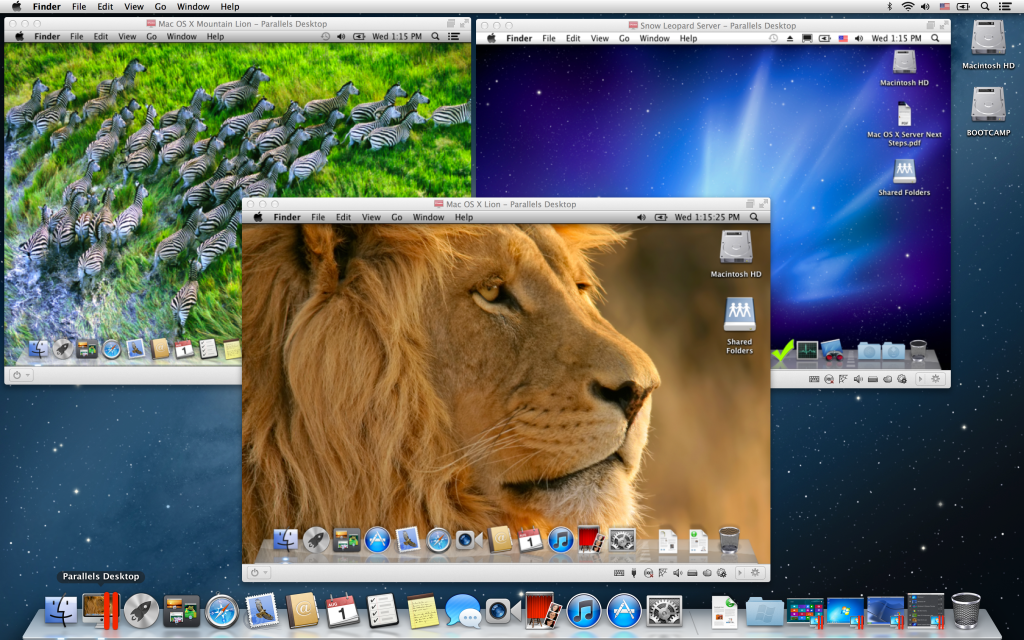 As ds store clarified, your current Parallels/Windows virtual machine file should upgrade without problems, so there is absolutely no need to purchase a new WIndows disk. If you go online to Parallels, the current version of Parallels, (optimized to work with OS X Lion) is Parallels Desktop 7 for Mac. I wanted to clarify with him that an OEM Windows disk worked just as well as a full retail version for an initial installation.
Get Started With Parallels
Parallels starts up with a menu for creating a new virtual machine or opening an existing one. This is where Parallels' focus on ordinary end users shines best. Unlike all other virtualization apps, Parallels doesn't expect you to have a Windows or Linux installer disk or disk image ready when you start it up, although it can use that image if you have one. Instead, Parallel's user-helpful menu lets you buy a Windows 10 download directly from Microsoft, or simply download a Windows 10 installer if you already have a license key.
Download Parallels Desktop For Mac
Another set of options lets you install a Parallels system-export utility on your Windows PC, and export it to Parallels via a network (slowly) or an external drive. A scrolling list at the foot of the menu lets you download specific versions of Linux or Android, install a virtual copy of macOS from your Mac's hidden recovery partition, or install Windows from a Boot Camp partition if you have one.
Like VMware and VirtualBox, Parallels supports a Snapshot feature that lets you save a guest system in one or more configurations that you know works well, and then restore a saved configuration after making changes in the system that you don't want to preserve. However, Parallels is unique in supplementing this feature with a Rollback option that automatically discards all changes to a system when you shut it down, so it works like a kiosk system, returning to its pristine condition every time you power it up. This feature can be invaluable in testing, or in environments like schools where users are liable to leave systems a lot messier than they found them. If you used Microsoft's long-abandoned VirtualPC app, you'll remember this feature, and will welcome its return in Parallels.
Parallel's Performance

Compared to VMware, Parallels starts up Windows at top speed in testing. On my vintage 2015 MacBook Pro, Parallels boots Windows 10 to the desktop in 35 seconds, compared to 60 seconds for VMware. VirtualBox matches Parallels' boot speed, but it performs far fewer integration tasks while booting up. For example, VirtualBox doesn't provide printer integration and the ability to open Windows files with Mac apps and vice versa.
One reason for Parallels' bootup speed advantage is that Parallels uses an emulated PC BIOS that supports the Fast Startup option, and the others don't. The speed difference isn't nearly as obvious when running Windows apps after the OS starts up, however. Parallels feels slightly faster than its rivals, but not drastically so. Fast as it is, Parallels won't satisfy hard-core gamers because Parallels, like VMware Fusion, only supports DirectX 10, while VirtualBox only supports DirectX 9. There's nothing that Parallels can do about this limitation, which is the result of the Mac's limited support for OpenGL (Open Graphics Library) features.
By default when Parallels runs a Windows system, any files on your Mac desktop will also appear on your Windows desktop. This may sound convenient, but it's a feature that I always to turn off in Parallels' settings dialog. One reason I turn it off is that it leaves the Windows desktop cluttered. Another is that much of what I keep on my Mac desktop—like folders and apps—simply won't work when I click on them in Parallels' Windows desktop. Parallels tends to go overboard with integration features, turning them on by default whether you want them or not.
Another way Parallels goes overboard with its integration is its tendency to clutter up its dialogs and your Mac system with icons and folders that you probably don't want. For example, by default, it adds a folder full of Windows application to your Mac's dock, and a Parallels menu to Mac's menu bar—though you can turn these off by poking around the options and preferences windows. Some of Parallels' menus include links to a set of Mac-related utilities called the Parallels Toolbox; some of these utilities, like a quick disk-cleaning menu, are convenient, but you probably don't want all of them, and they have nothing to do with virtualization. Another link on Parallels' menus invites you to buy Acronis True Image backup software, which you probably don't need if you use your Mac's built-in backup features.
Parallel Computing
Anyone who wants to run a Windows app on the Mac should choose between our two Editors' Choice apps, Parallels Desktop and VMware Fusion. For IT managers, developers, and for many tech-savvy users, VMware is the best choice. For most home, school, and SOHO users who don't need VMware's unique cross-platform support and legacy features, Parallels Desktop is the fastest, most hassle-free way to run Windows apps on a Mac.
Parallels Desktop (for Mac)
Bottom Line: Parallels Desktop is an excellent way to run Windows apps on MacOS, especially for ordinary users. It's fast in testing, offers tight integration between Macs and guest systems, and supports many other OSes, too.
Other Parallels Software International System & Performance
- $79.99
- $79.99
- $49.99