


Parallels For Mac Reclaim Disk Space
Posted on by admin
Parallels For Mac Reclaim Disk Space 4,2/5 8616 votes
I’m going to walk you through the process of resizing a Windows 10 VM running on Parallels Desktop 11 for Mac Pro Edition, but the steps are very similar (if not the same) for other operating systems and editions/versions of Parallels Desktop. The “Free up Disk Space” notifications display how to archive data and reclaim space—plus, you can utilize Clean Drive in Parallels Toolbox to save even more space. Graphics Improvements Stay up to date with changes to video memory allocation and improved OpenGL support.
Parallels, the company best known for developing a tool that allows Mac users to run Windows alongside macOS, has launched Parallels Toolbox 2.5 for Mac and Parallels Toolbox 1.5 for Windows.
Featured
This updated suite of easy-to-use tools streamlines all routine computing chores that you do many times a day and turn them into actions you can carry out with a click or two, massively boosting their productivity.
Must read: Apple products you shouldn't buy in 2018
Reclaim Disk Space Windows Server 2008
The updated suite contains new tools, and some updated tools:
New tools in Parallels Toolbox 2.5 for Mac include:
- Screenshot Page - Capture and print lengthy web pages that don't fit into your screen This is a super easy way to screenshot long web pages into a flat image. It doesn't matter if the page is way longer than the screen because the tool will auto-scroll to make the capture possible.
I've been a long-term user of SnagIt for years now, but this feature is fast becoming my go-to tool. - Free Memory - Reclaim RAM memory and optimize its consumption on your Mac Need a little more RAM to carry out a task? The Free RAM tool can offer you a little relief, although in testing I find that this tool can be a bit hit-and-miss - sometimes it frees up a lot of RAM and other times not much at all. But what have you got to lose?
I find that macOS is already very good at managing RAM, but if you do a lot of switching between resource-hungry applications, this can be a way to free up memory without having to reboot. - Resize Images - Batch convert images to your desired file size and format
I work with a lot of images in a day, and being able to carry out batch resizing or switch between file formats easily is a massive time saver. I've used this to batch convert well over 100 images and it handled it quickly, easily and effortlessly, and was much better than my previous workflow that involved either Photoshop or using SnagIt.
Parallels Desktop 14® for Mac makes it easier than ever to get back space on your Mac! Get up to 20 GB back with new disk usage optimization. Automatically reorganize your virtual disk to. Virtualization software like Parallels is usually associated with running Windows on a Mac, but virtualization can be used to also run other versions of macOS. I’ve been able to safely tinker with Apple’s latest developer or public beta by using virtualization to run them right inside the current stable release of macOS. I also keep [].
Parallels For Mac Reclaim Disk Space
New tools in Parallels Toolbox 1.5 for Windows include:
- Presentation Mode - Avoid embarrassing disruptions Put an end of a cluttered desktop, random notifications, emails popping up and your PC going to sleep ruining your presentation. A single click of a button can put an end to all this!
- Clean Drive - Reclaim disk space before you run out
Find duplicate files, uncover what the largest files on your hard drive are, and send them to oblivion with a couple of clicks. Deleting files is not necessarily the safest way to free up disk space, but the ability to root out huge files or duplicates is one of the safest. The ability to find duplicate files -- even if they've been renamed and moved to a different folder -- is especially useful. - Switch Resolution - Instantly make your screen easy on the eyes
A quick and easy way to switch screen resolutions without having to dig in the bowels of Windows.
Parallels Toolbox Business Edition
IT admins get total control with Parallels Toolbox Business Edition, so they can configure licensing and have control over what features users get access to.
Don't want people deleting files? No problems? Block screenshotting? Easy. Remove the ability to download videos or make GIFs? I don't blame you!
'Many employees lose valuable time every week struggling with how to get basic things done simply and quickly -- like prevent presentation disruptions, clean the drive, record video of their screen to share or convert to the right format, securely archive files and more. Available solutions are unnecessarily complex, and manual steps can be hard to remember,' said Jack Zubarev, President of Parallels. 'With Parallels Toolbox, users and businesses can quickly accomplish common tasks in just a click, and it provides an ever-growing suite of tools at their fingertips to get things done and be more productive.'
Parallels Toolbox 2.5 for Mac and Parallels Toolbox 1.5 for Windows are available today as a stand-alone product and cost $19.99 per year per seat.
NEXT PREV
See also:
Related Topics:
Smart Office CXO SMBs Tech Industry Enterprise SoftwareActive2 years, 4 months ago
In Parallels Desktop 12.2.0 on MacOS 10.12.4, a Windows 10 VM is taking up over 170GB of mystery space. Windows only sees a 128GB drive. But Parallels claims to be using 300GB on hard disks.
It's not snapshots-- Parallels reports only 22GB for snapshots. It's not multiple disks-- Parallels reports only one hard disk. It's not unpartitioned space on the Windows side-- Windows reports no significant unpartitioned space. It's not multiple VMs because Parallels reports only one VM, which I've confirmed by seeing only one 346GB VM file in Finder.
But the space is definitely getting chewed up, because my Mac is low on disk space. WTF? Anyone know where that mystery 170GB is being used, and how to free it up?
Justin Grant
Justin Grant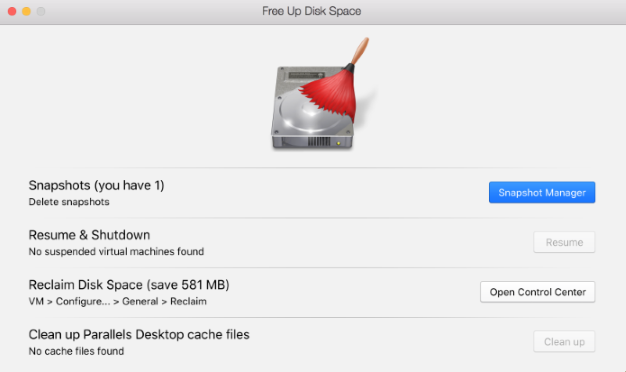 Justin Grant
2341 gold badge3 silver badges18 bronze badges
1 Answer
After a long chat with Parallels support followed by my own investigation, it turns out that the mystery disk space is taken up by snapshots. But Parallels apparently has a bug where it's not correctly reporting the full disk space cost of snapshots. By deleting some snapshots I was able to reclaim much of the mystery disk space.
Here's more details. Apparently Parallels stores snapshots in two places: inside your VM's .pvm file (go to /Users/YourName/Documents/Parallels, find the .pvm file, right click on it, and choose 'Show Package Contents') :
- in a
Snapshotsfolder, which is what's measured by the green Snapshots area in the General tab of Parallels VM configuration. - inside the
.hddfile that contains the actual hard disk data. If you right-click on this file and choose Show Package Contents, you'll see one.hdsfile for each snapshot that you have stored. These files are not included in the green Snapshots area in the General tab of Parallels VM configuration.
I deleted several old snapshots using the Snapshot manager, and that freed up 100GB in just a few minutes. Removing each snapshot removed one 10GB+ .hds file from inside the .hdd file.
Linux Reclaim Disk Space
I did see cases in the Parallels forums where old snapshots didn't show up in Snapshot Manager but were still using up disk space. Apparently there's a Terminal-based way to fix that problem. I'm pasting links here in case others run across that variant of the problem:
Windows media player 12 download for mac. both linking to:
I was disappointed in Parallels for not accurately measuring the true disk cost of snapshots. Had Parallels correctly noted that snapshots were taking up 200GB vs. 128GB for real disk space, the solution (delete some snapshots, dummy!) would have been obvious. Instead I wasted hours trying to troubleshoot what could have been a simple problem to resolve.
The support engineer I worked with claimed that this incorrect measurement is not a Parallels bug. I'll leave it up to you to decide if you agree with him. ;-)
klanomath51.4k7 gold badges76 silver badges144 bronze badges
Justin GrantJustin Grant2341 gold badge3 silver badges18 bronze badges